
We saved our visit to Jerónimos Monastery until the very end of a month-long stay in Lisbon. So, was it worth the wait? We think so!
Sure, it’s one of the most popular attractions in the city—right up there with São Jorge Castle. But they seem to do a good job of funneling loads of visitors through in an efficient manner. Even on a Sunday (free to locals), the monastery didn’t feel overwhelming.
Whether you’re a first-time traveler to Lisbon, history buff, connoisseur of Gothic architecture, or simply want to walk in the footsteps of Portugal’s legendary explorers, we think Jerónimos Monastery is a must-see.
This detailed guide walks you through everything you need to know: when to visit, what to see, how to avoid long queues, ticket tips, Belém highlights, and much more.
⭑ Looking for the best ways to visit? ⭑
✪ Our personal pick for a guided tour is this Belém + Jeronimos Monastery small-group walking tour
✪ Short on time? See Belém by tuk-tuk (with a stop at Jerónimos Monastery)
✪ Save money on entry to Jerónimos Monastery + 51 other attractions with a Lisbon Card (24, 48, or 72-hour pass)
This post contains affiliate links. If you click and make a purchase, we might receive a commission (at no added cost to you). Thanks for supporting independent, ad-free blogs!
- Why Visit Jerónimos Monastery
- The Best Ways to Experience Jerónimos Monastery
- The Best Way to Buy Tickets
- Transportation Tips
- What to See + Do
- Around the Monastery + Belém
- A Suggested Half‑Day Itinerary in Belém
- Best Time to Visit
- Where to Eat in Belém
- Final Thoughts
- More Reading for Your Portugal Trip
Why Visit Jerónimos Monastery

There are a ton of reasons why we think you might want to visit Jerónimos Monastery. We’ve cherry-picked our top five and cover them below.
A Celebrated UNESCO World Heritage Site
Recognized globally for its aesthetic and cultural significance, the monastery is protected as a UNESCO World Heritage Site alongside the nearby Belém Tower.
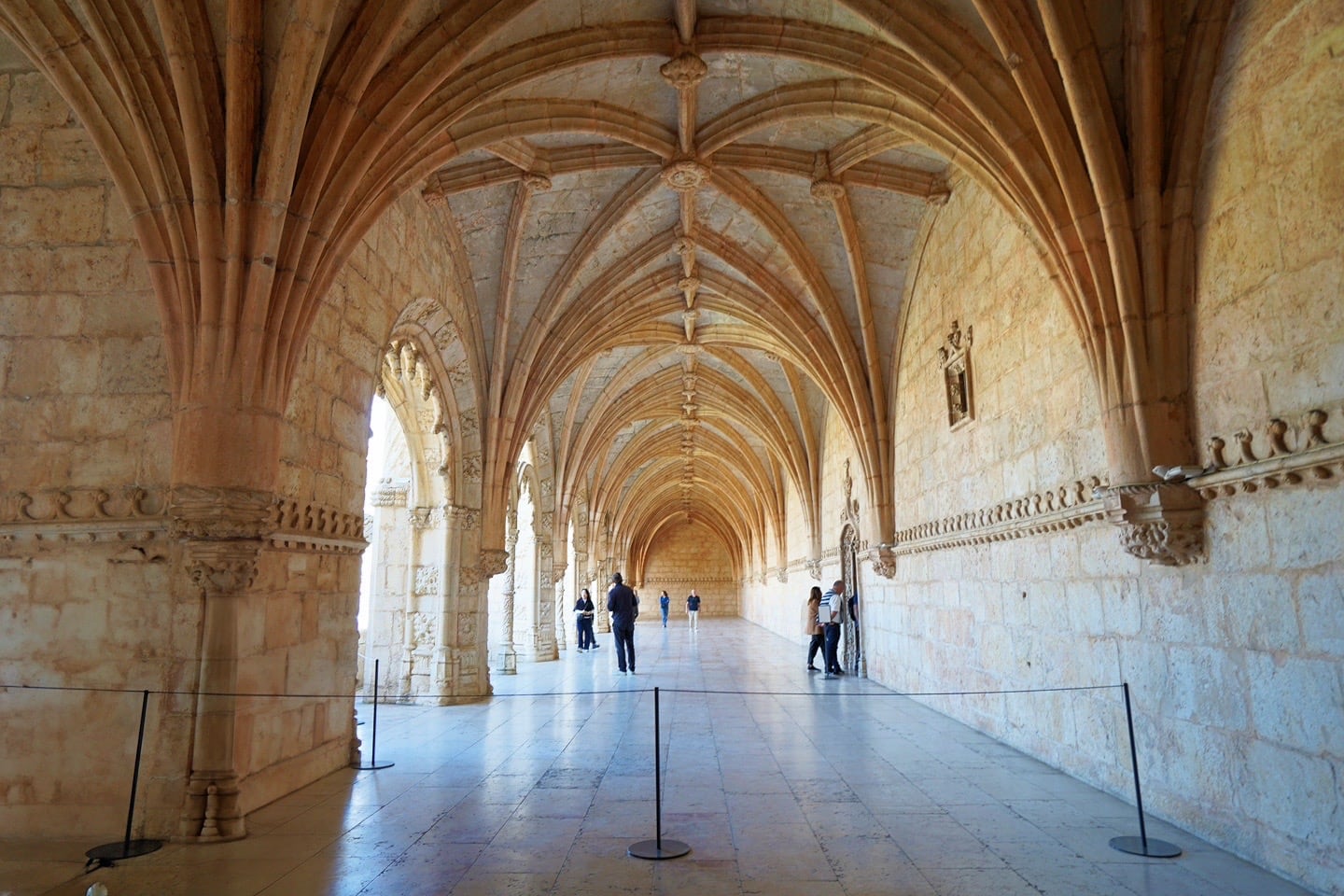
We were blown away by the Manueline style architecture—a unique Portuguese blend of Gothic, Renaissance, and maritime flourishes—which we would characterize as flamboyant and over-the-top (in a good way!).
A Spiritual Home of Exploration
Built at the height of Portugal’s maritime power, the monastery was a place where sailors would go to pray and prepare themselves for a long journey across seas.
Many voyages that shaped history (for better or worse) were blessed here, making it a symbolic gateway to the world.
A Haven of Tranquility in Busy Belém
This place is a crazy popular attraction. Yet, we were suprised to discover it is still possible to find calm and peace within the cloister.
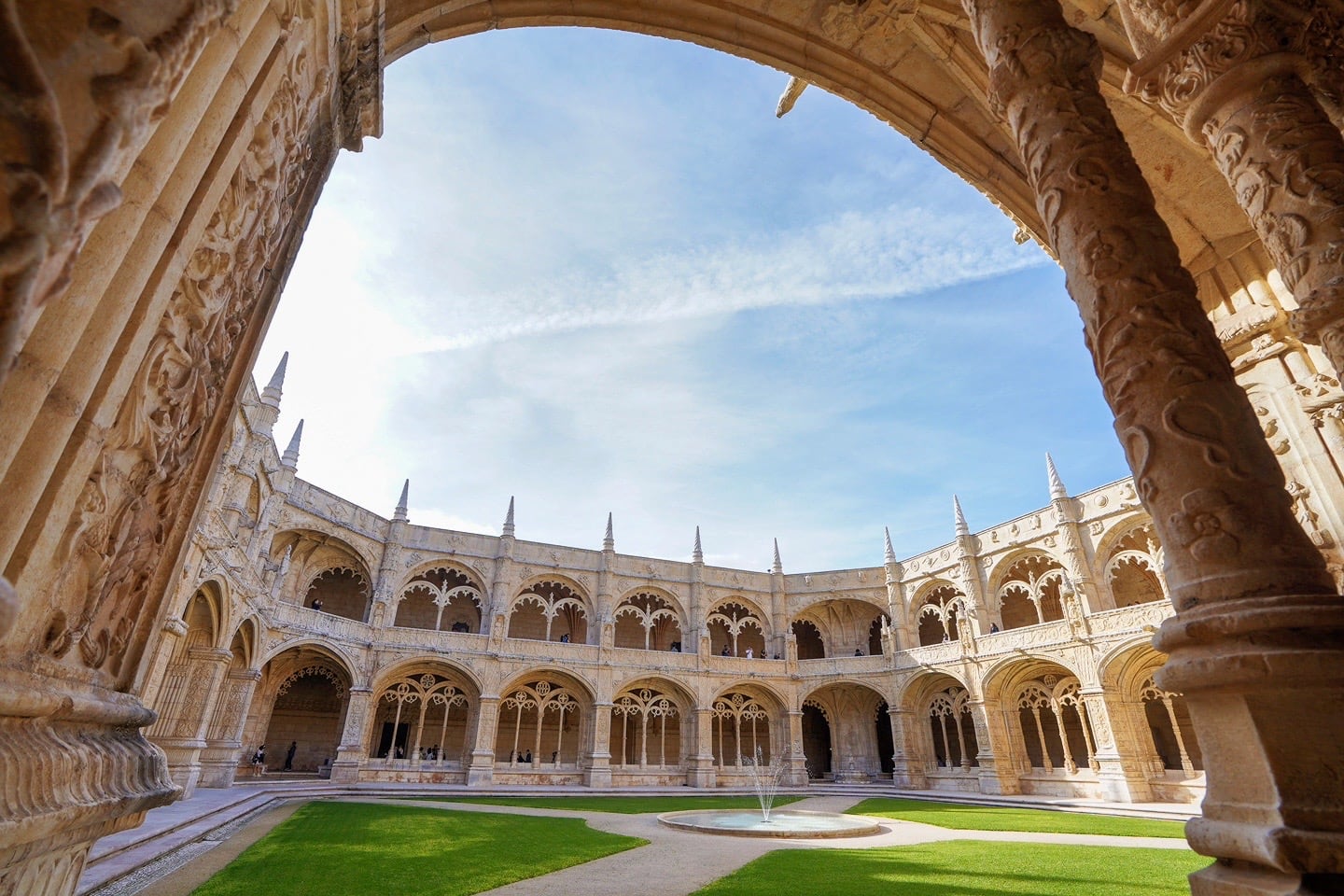
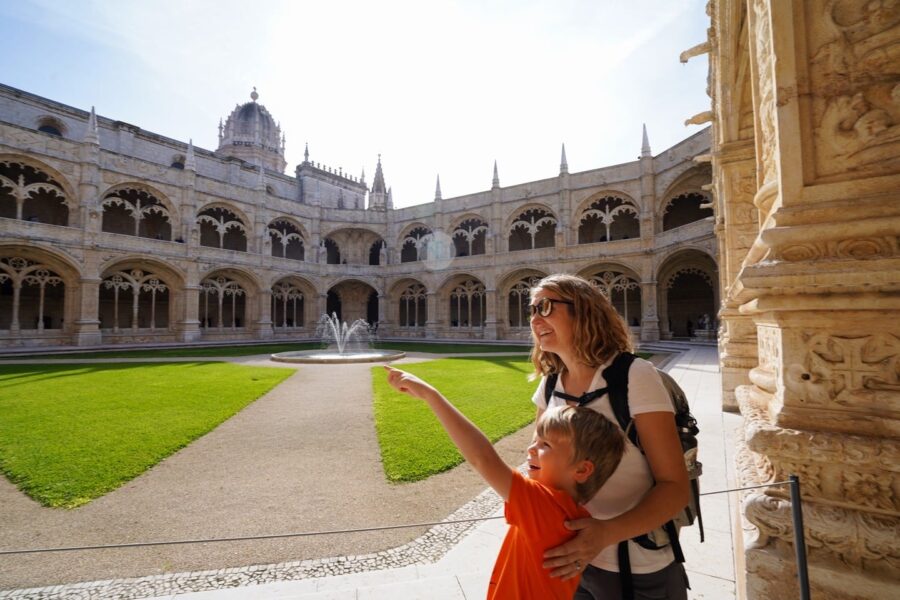
The inner courtyard is big enough to accommodate hundreds, making for one of the better places in the complex to spread out and find a quiet corner.
A Cornerstone of Lisbon’s Cultural District
Belém is packed with major attractions: the Monument to the Discoveries, the Belém Tower, the National Coach Museum, and the world‑famous Pastéis de Belém bakery.
At the center of it all is Jerónimos Monastery, which acts as something of an anchor, tying the district and its many stories together.
A Place Where You Can Feel History
From the tombs of Vasco da Gama and Luís de Camões to the intricately carved maritime motifs on seemingly every wall, the monastery is loaded with lots of little details to connect you to the past.
The Best Ways to Experience Jerónimos Monastery
There’s not really a bad way to visit this place. But if you want to get the most out of your experience, we’ve got a few tips to offer.
Jerónimos Monastery can be explored in several different ways depending on your pace, interests, and how much of Belém you want to see in one go. Here are our recommendations:
Join a Walking Tour Combining Belém’s Highlights
Walking tours are one of the best ways to understand the monastery’s history in context.
Guides connect the many intricate physical aspects of the cloister and church with the broader history of the Age of Discovery and Lisbon, itself—so it’s clear what the heck it is you’re actually looking at.
✪ Currently, this one’s our top pick: Belém + Jeronimos Monastery small-group tour.
Most walking tours include:
- Jerónimos Monastery
- Belém Tower
- Monument to the Discoveries
- Waterfront viewpoints
- A stop at Pastéis de Belém for traditional pastries
We think this option is ideal for travelers who appreciate depth, storytelling, and a well‑paced introduction to the district.
Explore Belém by Tuk Tuk
Lori and I love tuk tuks! Maybe it’s the four years we lived in Southeast Asia, or just that they’re a great way to get around a place.
Tuk tuk tours offer visitors a fun, fast, and scenic overview of the entire Belém district. Many include dedicated time for the monastery, allowing you to explore independently after a lively introduction to the area.
✪ Check out this top-rated option: Lisbon: Discover Belem by electric Tuk Tuk.
A tuk tuk tour works well for travelers who want:
- Convenience and minimal walking
- A personable local guide
- A quick way to explore multiple nearby attractions in one go
We especially recommend this option for travelers visiting on a hot day or who have a tight schedule in Lisbon.
Create Your Own DIY Exploring Route
Belém is compact, flat, and easy to navigate (no hills here, yay!), making it ideal for self‑guided travel. A DIY itinerary lets you spend as much time as you want inside the monastery’s cloisters and hop between attractions without being rushed.
A suggested DIY route:
- Start at Jerónimos Monastery right at opening time.*
- Walk to Pastéis de Belém for a pastry break.
- Stroll east toward the Monument to the Discoveries.
- Continue along the river to Belém Tower.
- Add optional museum visits such as MAAT or the National Coach Museum.
This option offers the most flexibility, especially for photographers, slow travelers, or anyone who enjoys moving at their own pace.
* It’s helpful to keep in mind that the monastery’s famous church—Igreja de Santa Maria de Belém—has its own hours of operation separate from the main monastery. Most days it opens at 10:30am, but if you plan to visit on Sunday, it doesn’t open until 2pm (which we found out the hard way).
Choose a Belém Pass or Combo Ticket
Combo tickets (such as the Lisbon Card) include Jerónimos Monastery and nearby attractions. Such passes streamline your sightseeing day in Lisbon with skip‑the‑line access and can save you quite a bit of money in the long run.
A combined pass is best for travelers who:
- Plan to explore Belém for a half or full day
- Prefer no-fuss, pre‑planned entry to major sites
- Want to avoid having to buy and manage multiple separate tickets
The Best Way to Buy Tickets
As we mentioned above, Jerónimos Monastery is one of Lisbon’s busiest attractions, so being strategic with your ticket-buying matters! Here are our top tips for getting your tickets:
Buy Online in Advance
This tends to be the quickest and most reliable route for most travelers. Tickets are timed-entry, which helps regulate crowds and reduces your time waiting in line, in many ways making it easier for you to plan the rest of your day in Belém.
You can buy tickets online at Viator.com, GetYourGuide.com, or the monastery’s official ticketing website.
Combo Tickets
A combined pass is a smart choice if you want to see more than just the monastery (there’s lots to see around here, and in the rest of Lisbon, for that matter!).
Popular bundles such as the Lisboa Card include Jerónimos Monastery, Belém Tower, and the National Archaeology Museum. These passes save you money, take the worry out of ticket buying, and cover many of Belém’s top highlights.
Worst Option: Buying On‑Site
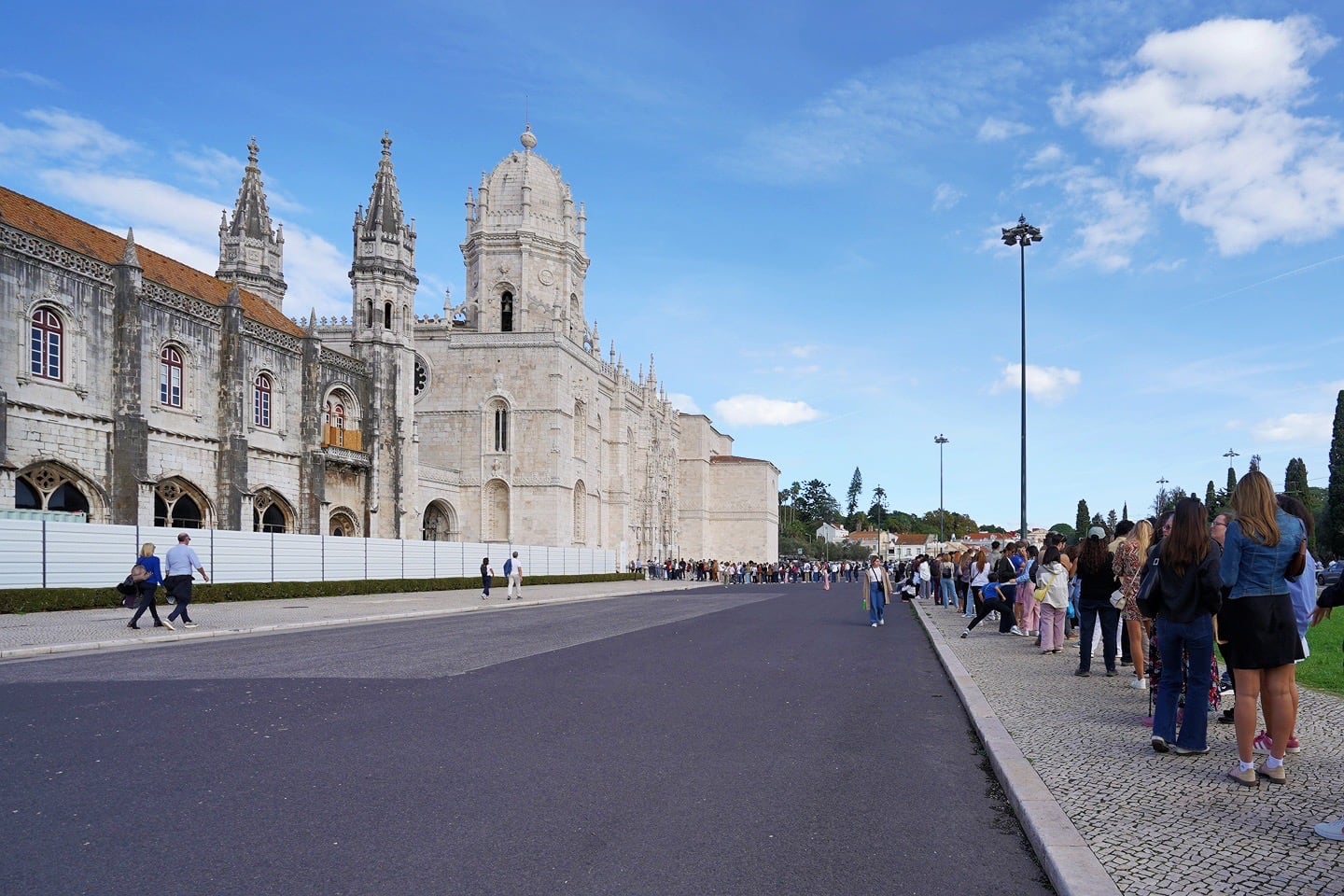
Lines at the ticket office can get VERY long during peak months, often stretching for hundreds of meters.
Generally, this approach only makes sense if you arrive right at opening and have patience and flexibility, as there is a good chance you might not get a time slot until later in the day (or the next).
Free Sundays
Portuguese residents receive free entry on Sunday mornings, creating some of the busiest hours of the week. If possible, foreign visitors should plan around this window to avoid heavy crowds and enjoy a less hectic experience.
Transportation Tips

Belém is located about 6 km west of central Lisbon, but don’t let that spook you. Because of the neighborhood’s many popular attractions, there are several reliable transport options to Jerónimos Monastery from central Lisbon.
If you choose to go by public transit, we’ve had good luck using the Citymapper app (and Google Maps app) to figure out schedules, routes, and stops.
Here are the transport options to consider:
Tram 15 (Electrico)
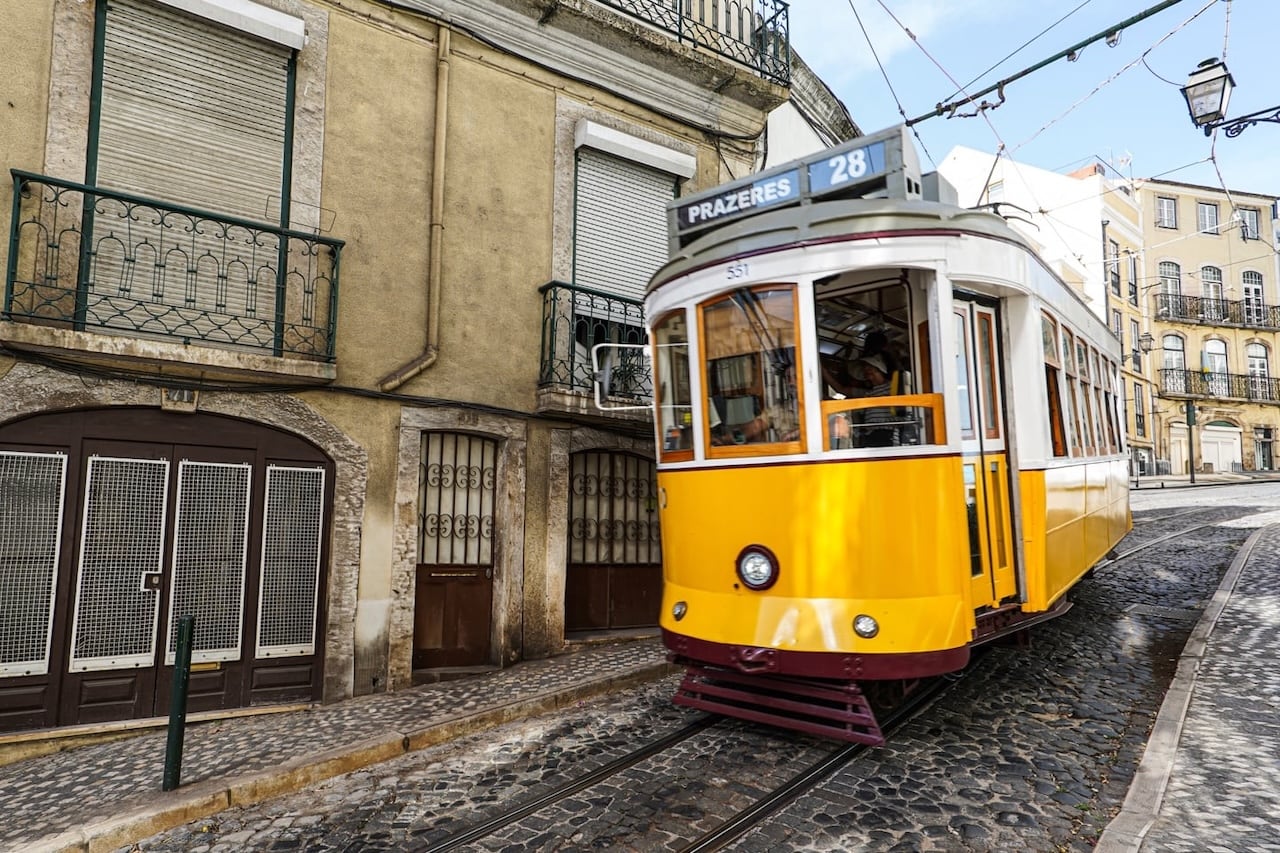
The Tram 15 seems to be the most common way people get from central Lisbon (Baixa) to Belém.
Departing from Praça da Figueira and Praça do Comércio, it runs along the waterfront and drops passengers just a short walk from the monastery (hit the red button on the tram just before Mosteiro Jerónimos tram stop.
It’s popular with both visitors and locals, so be prepared for crowds (and watch your valuables). Nonetheless, it’s a straightforward and scenic ride.
Train
Another efficient option is the Cascais Line train from Cais do Sodré to Belém station. The journey by train to Belém takes only a few minutes, and trains run frequently throughout the day (but not as frequently as Tram 15).
This is a great option for travelers who prefer predictable timing and smaller crowds.
Bus
Several city bus routes also link central Lisbon with Belém, offering a flexible alternative if you’re staying outside the main tram or train corridors.
Buses stop close to the monastery and can be a practical choice during peak tourist hours or when the tram is experiencing delays.
Taxi / Ride-Share
For those who like door-to-door convenience, taxis and ride-share services provide quick access to Belém at reasonable prices, especially if you are traveling with a group of 2-4 passenger.
Traffic along the waterfront can occasionally slow things down, but overall it’s a smooth and comfortable way to get there.
Walking or Biking
If time and weather allow, walking or biking from Cais do Sodré can be a surprisingly enjoyable option.
The riverside path passes museums, parks, and views of the Tagus (Tejo) River, turning the journey to Jerónimos Monastery into part of the experience rather than just a trip across town.
What to See + Do
Jerónimos Monastery offers a multifaceted experience, blending blends craftsmanship, history, symbolism, and quiet reflection.
In this section, we talk a bit about each of the highlights of a tour around the monastery, so you can better plan your trip and be a bit prepared for what you’ll be seeing there.
It also includes our recommended order in which to view the various parts of the complex if you happen to be doing this tour on your own without a guide.
Church of Santa Maria de Belém
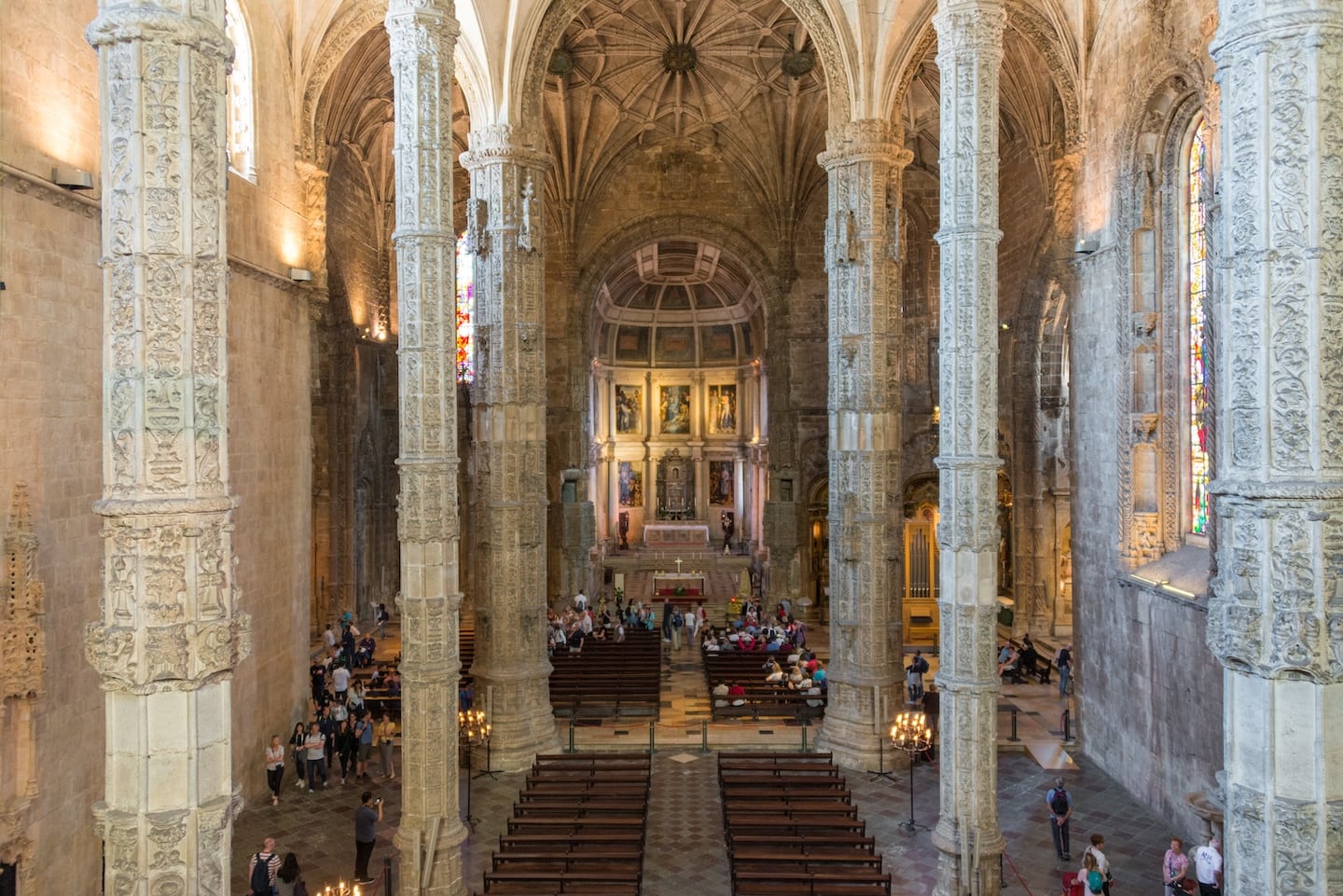
We strongly recommend starting your visit with the church (if it’s open), which nicely sets the stage for touring the rest of the complex.
The church sanctuary is an incredible and awe-inspiring feat of engineering. The columns evoke a stand of towering trees, rising upwards to support the vaulted ceiling.
Wandering around, it was suggested we take note of how seamlessly the ornamentation blends both maritime and religious motifs, which was apparently a hallmark of the Manueline style.
The tombs inside the church are a source of great price for the Portuguese. Vasco da Gama’s tomb celebrates the nation’s spirit of exploration, while the nearby tomb of Luís de Camões symbolizes the Portugal’s literary achievements.
It’s also worth noting that this church served as the last stop for mariners (both famous and less-known) to have a little time for prayer and reflection before hitting the high seas.
It was sobering to me to think what must have been going through their minds not knowing if they’d ever return to their homeland. This at such a time when the lands across oceans were still largely uncharted.
The Cloister
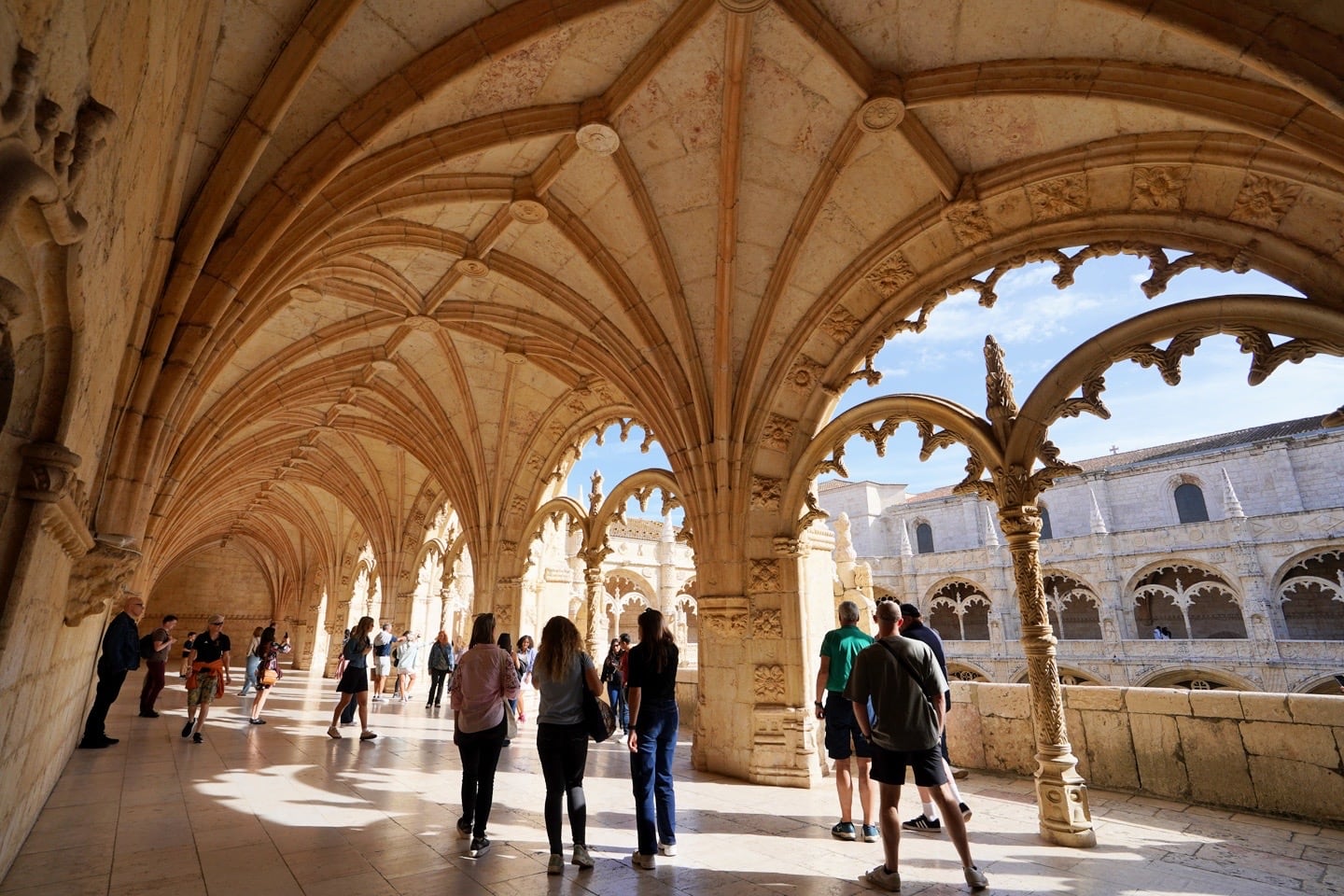
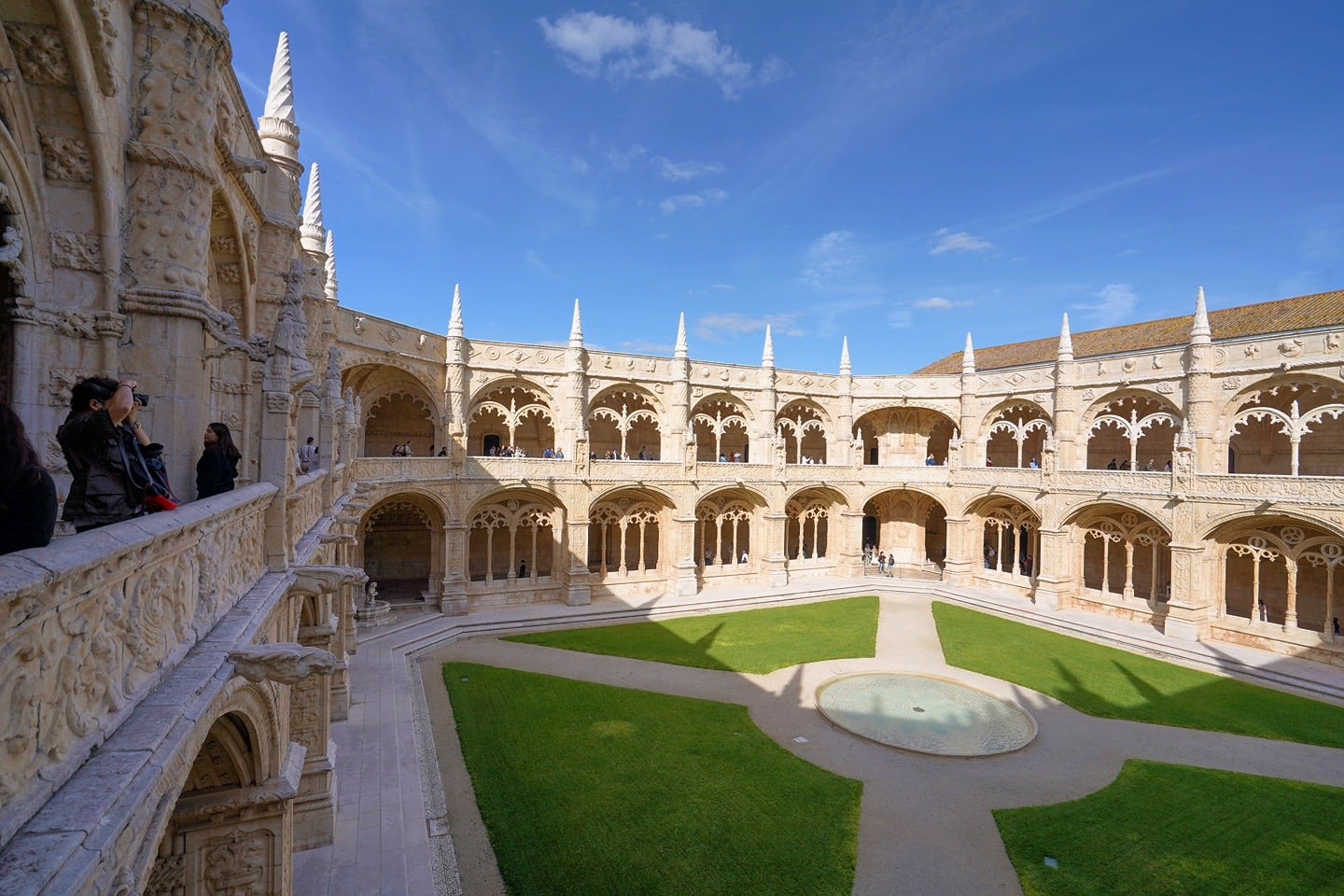
Stepping into the ticketed area, you’ll quickly find yourself in the cloister—the heart of the monastery and, for many, the highlight of the visit.
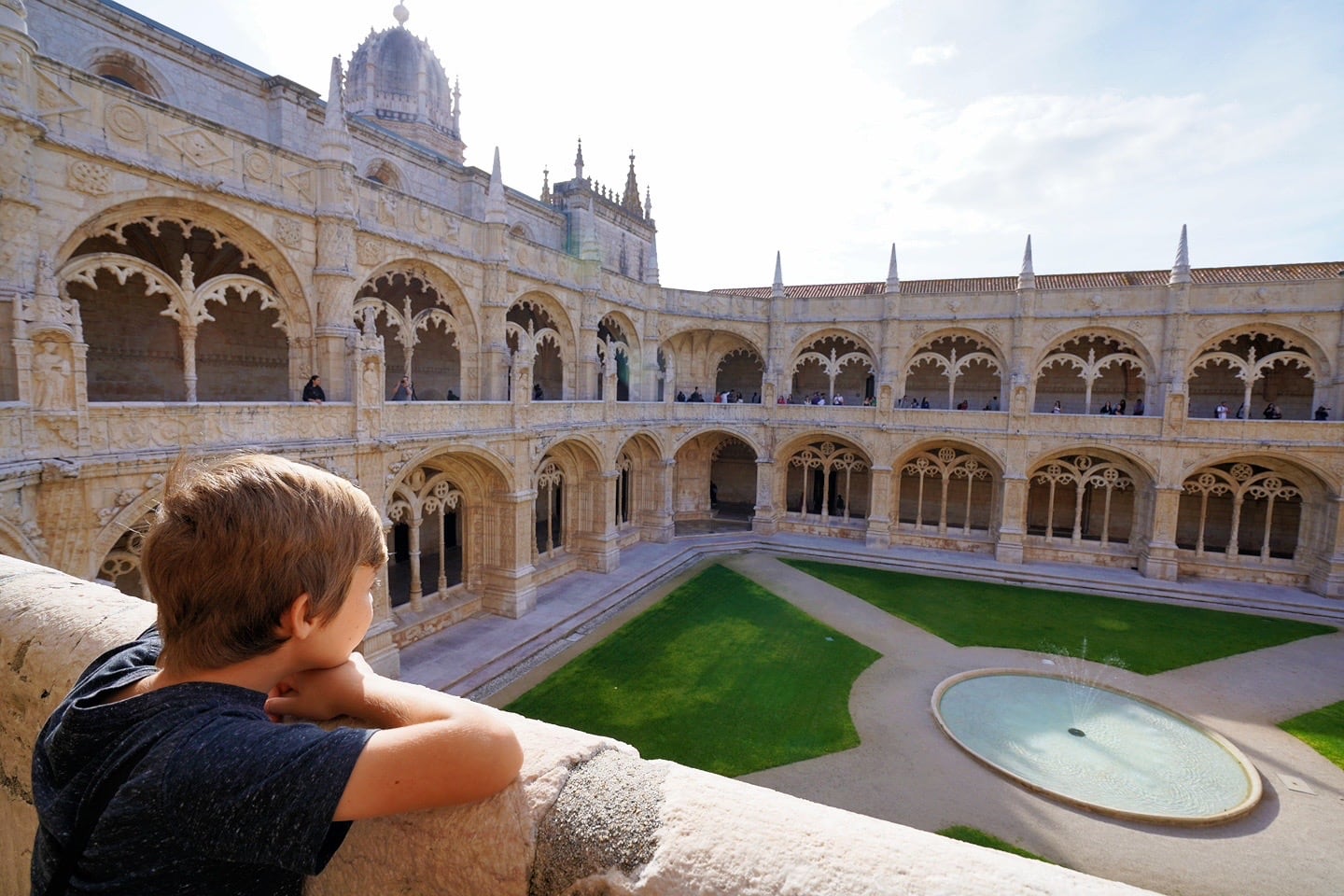
We recommend immediately heading upstairs to the second level for a birdseye view. After making a complete loop, head back downstairs and make your way around the ground floor level.
Designed to be both functional and meditative, the space blends Manueline craftsmanship with monastic serenity.
Lori and I tried to really take our time here. No one was rushing us, and we think the grandeur of the place deserves it. We walked the perimeter slowly, observing the carvings—not just the large motifs but the small details.
We were told to be on the lookout for:
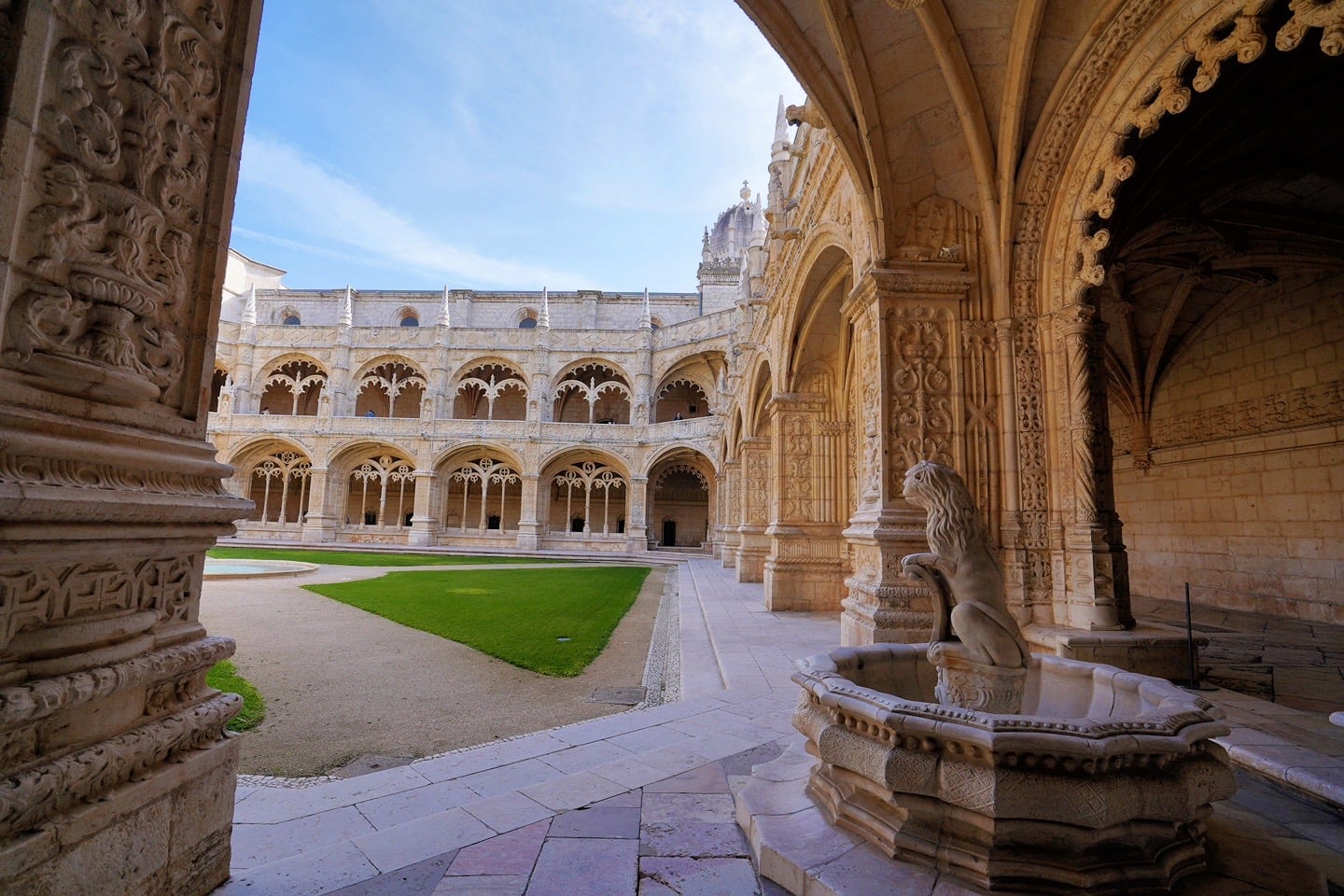
- Coiled ropes and twisted knots symbolizing Portugal’s seafaring achievements
- Sea creatures and flower imagery
- Gargoyles—both feirce and funny!
- Subtle differences between the lower and upper levels
We visited in the early afternoon, which lit everything in a warm tone, but cast harsh shadows which we could’ve done without—at least from a photographic standpoint.
Apparently, if you can get here earlier in the day, the light is more even, but softer and cooler (not as much ‘pop’).
The Chapter House
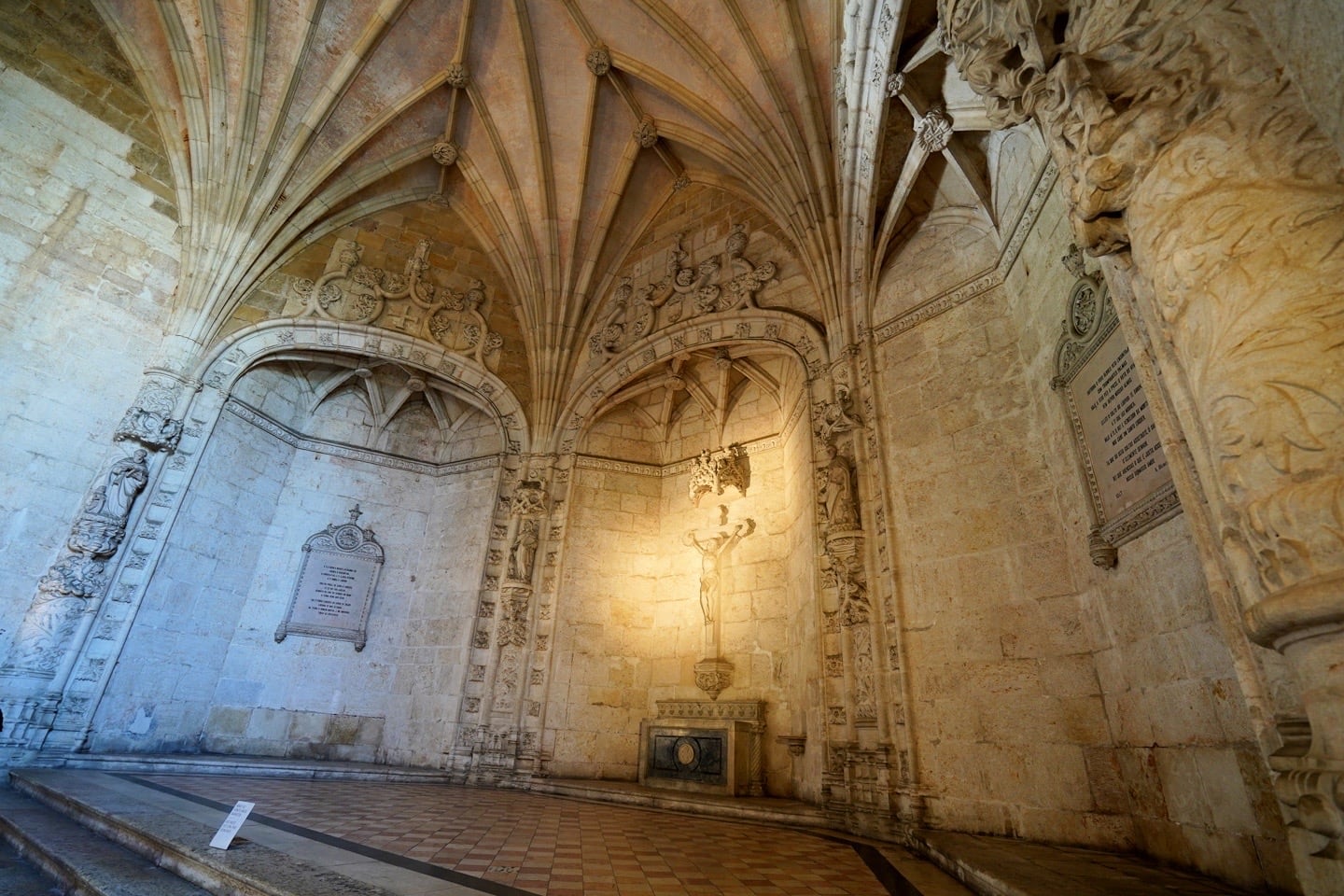
Once back on the ground level, we followed the steady stream of people heading to the Chapter House.
This part of the monastery has a completely different feel to it. One moment, we were in the an bright, wide-open space of the cloister. Then, suddenly we find ourselves in an enclosed hall that almost feels like a giant crypt or cellar.
One of the standout architectural features here is how the entire hall is supported by a single central column, which gives the appearance of the ceiling blooming outward in delecate ribs.
This was the administrative center of the monastery, where monks gathered to make important decisions, read scripture, and perform ceremonies.
The Refectory
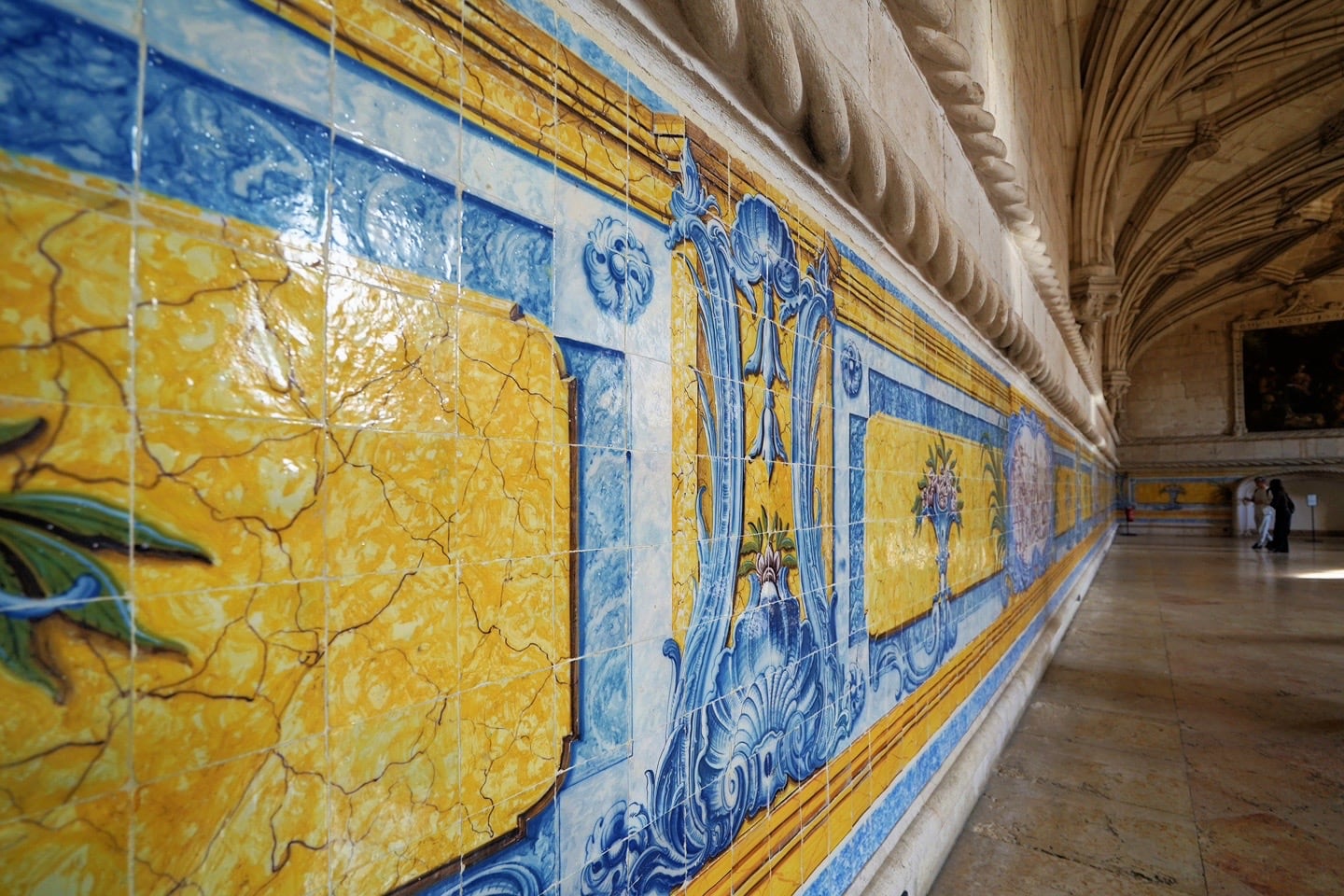
Also on the ground level, the refectory offers a lighter but also fascinating experience.
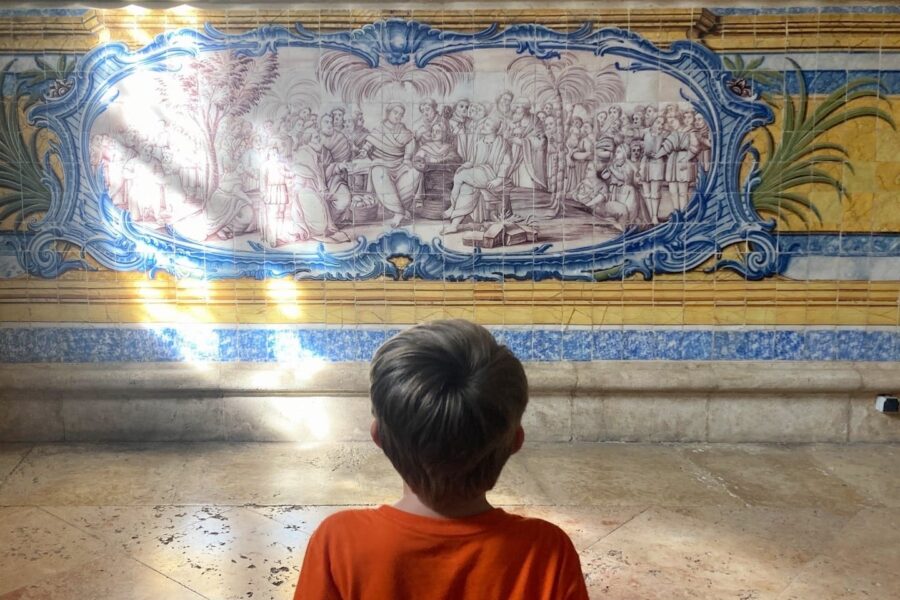
The long hall, lined with detailed azulejos, tells biblical and maritime stories through blue‑and‑white imagery.
If you look closely at the tiles, you’ll notice that they depict various stories, ranging from maritime tales to parables and teachings meant to offer moral instruction or reflection during mealtime.
Around the Monastery + Belém
One of the perks of visiting Jerónimos Monastery is that it sits at the center of Belém, one of Lisbon’s most culturally rich neighborhoods.
We stepped out of the monastery’s cloisters and literally, within minutes, found ourselves in easy striking distance of several major attractions. Here are some of the highlights nearby:
Maritime Museum
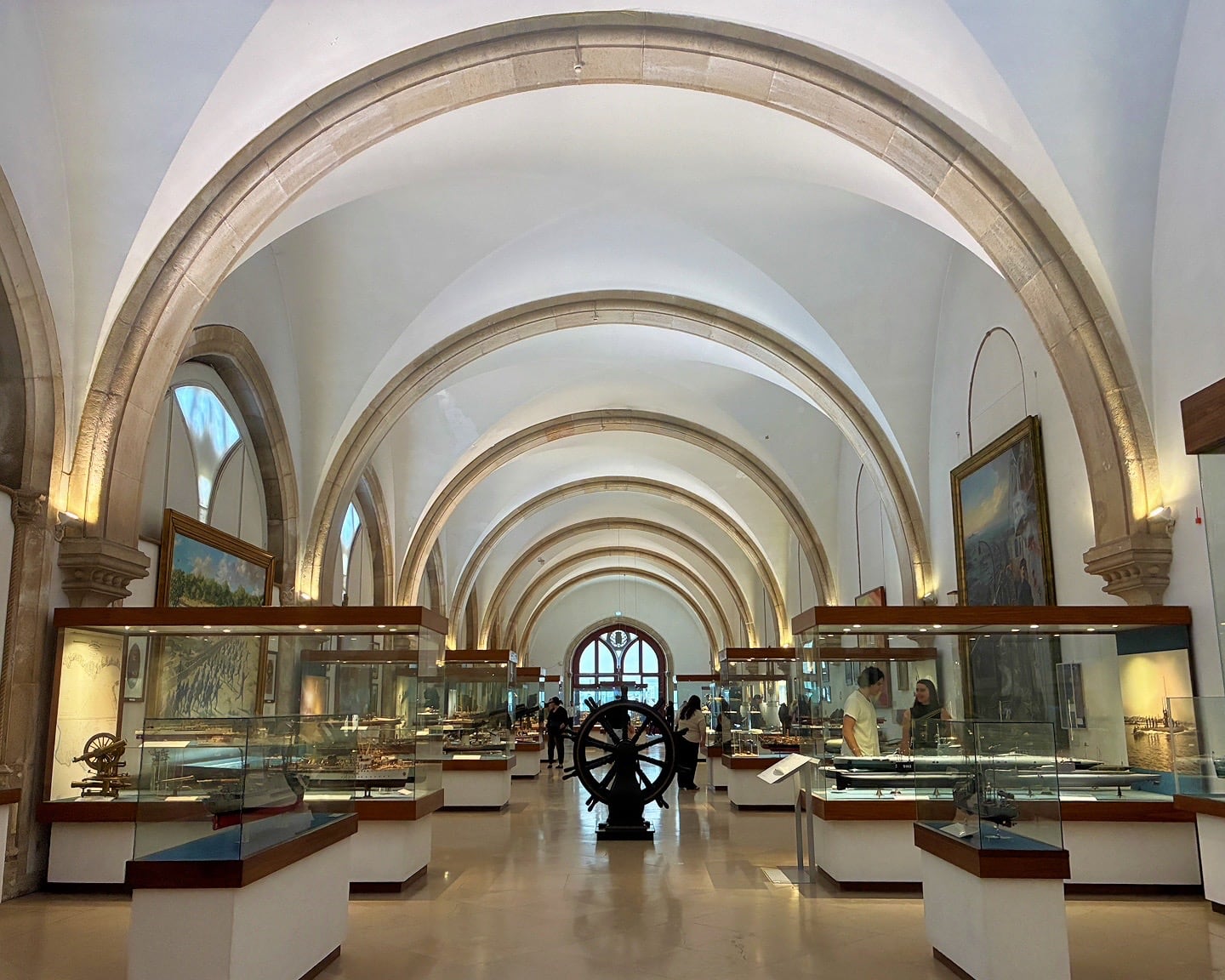
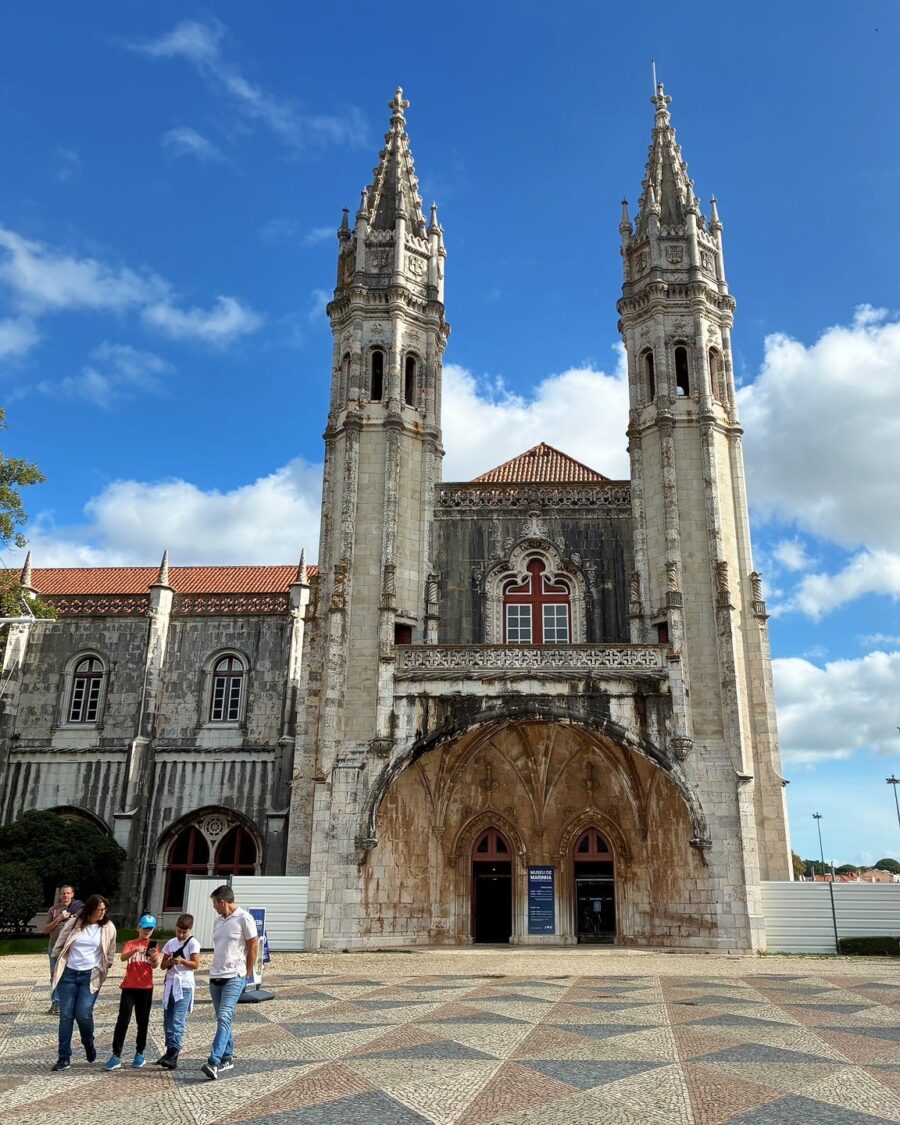
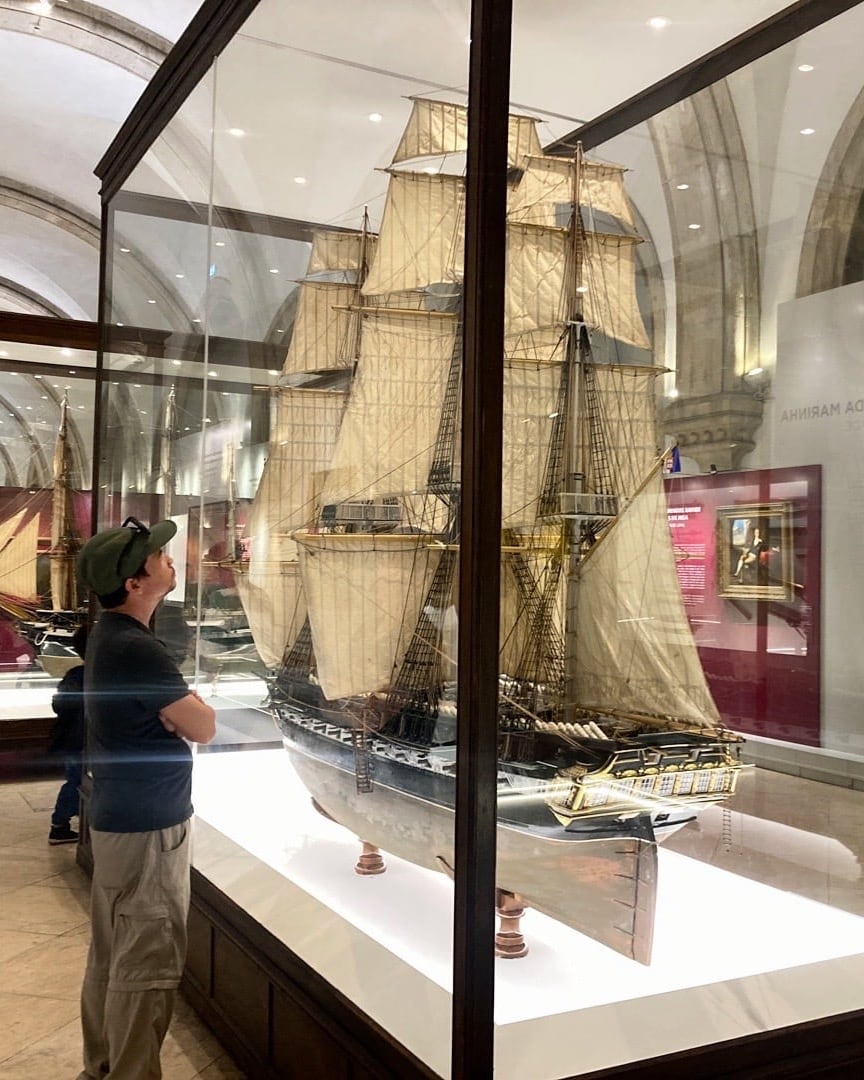
Right next door (actually within the same complext as the monastery—but with a separate entrance) is the Maritime Museum (Museu de Marinha).
If you’re curious about Portugal’s distinguished seafaring history, this is the place to start your exploration.
The museum collection includes royal barges, early navigational tools, and LOTS of intricate scale models that illustrate the rise of Portuguese exploration in a tangible way.
We thought the museum was large but well-organized, making it an easy add-on to our monastery visit.
Empire Square Garden
Across from the monastery, it’s impossible to miss the Empire Square Garden (Praça do Império), a spacious green area built around a large fountain that is known for reflecting the monastery’s limestone façade.
We found the garden to be a wonderful place to rest our feet, soak up the afternoon and enjoy views of the surrounding monuments. We saw many families also using it as a quick picnic stop before continuing on with their day.
Monument to the Discoveries
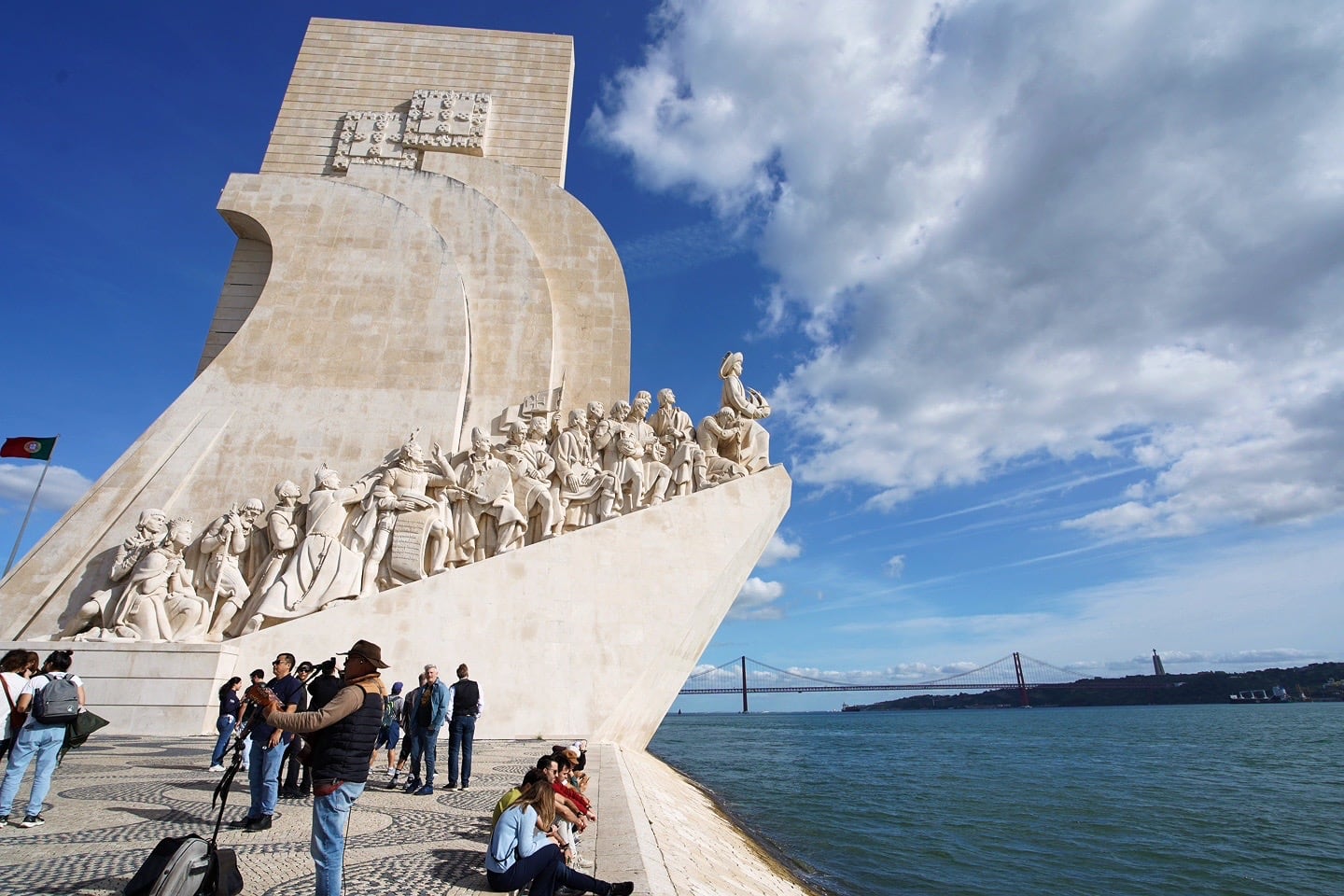
Continuing towards the river brought us to the Monument to the Discoveries (Padrão dos Descobrimentos), a striking structure built to commemorate Portugal’s Age of Exploration.
Most people here seem to come to study the intricately carved statues of historical figures, listen to street musicians perform, or sit on the banks of the river.
If you don’t mind waiting in another line and paying more money, you can also take an elevator to the top of the structure where there’s a viewing platform looking out over Jerónimos Monastery to the north and the Tagus/Tejo River and Lisbon’s famous 25 de Abril Bridge to the south.
Pastéis de Belém

We’d say that no visit to Belém is complete without a stop at Pastéis de Belém, the birthplace of Portugal’s famous custard tart.
The bakery has been serving its original recipe since 1837, and we can definitely see why. They are delicious! If it ain’t broke, don’t fix it, right?
Don’t be put off by the long line here, especially if you’re grabbing a pastel to go (para levar). There were a couple dozen people in front of us and we got through in about five minutes. So, yeah, they’ve been doing this awhile and it shows.
A Suggested Half‑Day Itinerary in Belém

If you want to make the most of your visit to the Belém district, here’s what suggest:
Start your morning at Pastéis de Belém, where the original custard tarts have been baked since the 1830s.
It’s one of the neighborhood’s signature experiences, and grabbing a warm pastry straight from the oven is a surprisingly easy—and delicious—way to kick off your day.
From there, walk a few steps to Church of Santa Maria de Belém, the free-to-enter portion of the monastery complex.
Its forest-like nave, vaulted ceilings, and intricate stonework offer a nice preview of the over-the-top Manueline architecture you’ll glimpse later inside the cloister.
When your reserved time arrives, head into the Jerónimos Monastery Cloister. This is the highlight of most people’s visit to the area, known for its symmetrical arches, carved columns, and tranquil courtyard.
Next, make your way to the Maritime Museum, located within the same complex (around the corner on the left).
The museum lays out centuries of Portugal’s nautical achievements, from royal barges to early navigation instruments, and it adds context to the Age of Discovery history tied to the monastery.
Afterward, take a stroll through Empire Square Garden, Belém’s wide-open and scenic garden near the river. It makes for a relaxing break between attractions offering a nice view.
Continue toward the Tagus River to take in the Monument to the Discoveries. This striking structure honors the explorers who shaped Portugal’s global reach.
Taking the elevator to the top will reward you with views of both the monastery and river.
A not-so-long riverside walk west brings you to Belém Tower, one of Lisbon’s UNESCO-listed landmarks.
It offers an interesting blend of defensive design and decorative details that make it a photogenic backdrop (unfortunately, the tower was closed for renovation during our visit in October/November 2025, hence the use of the stock photo, above).
Wrap up your half-day itinerary with lunch at one of the district’s casual cafes, or take the tram a few stops east to LX Factory (Estação De Santo Amaro stop) for more trendy bites.
Best Time to Visit
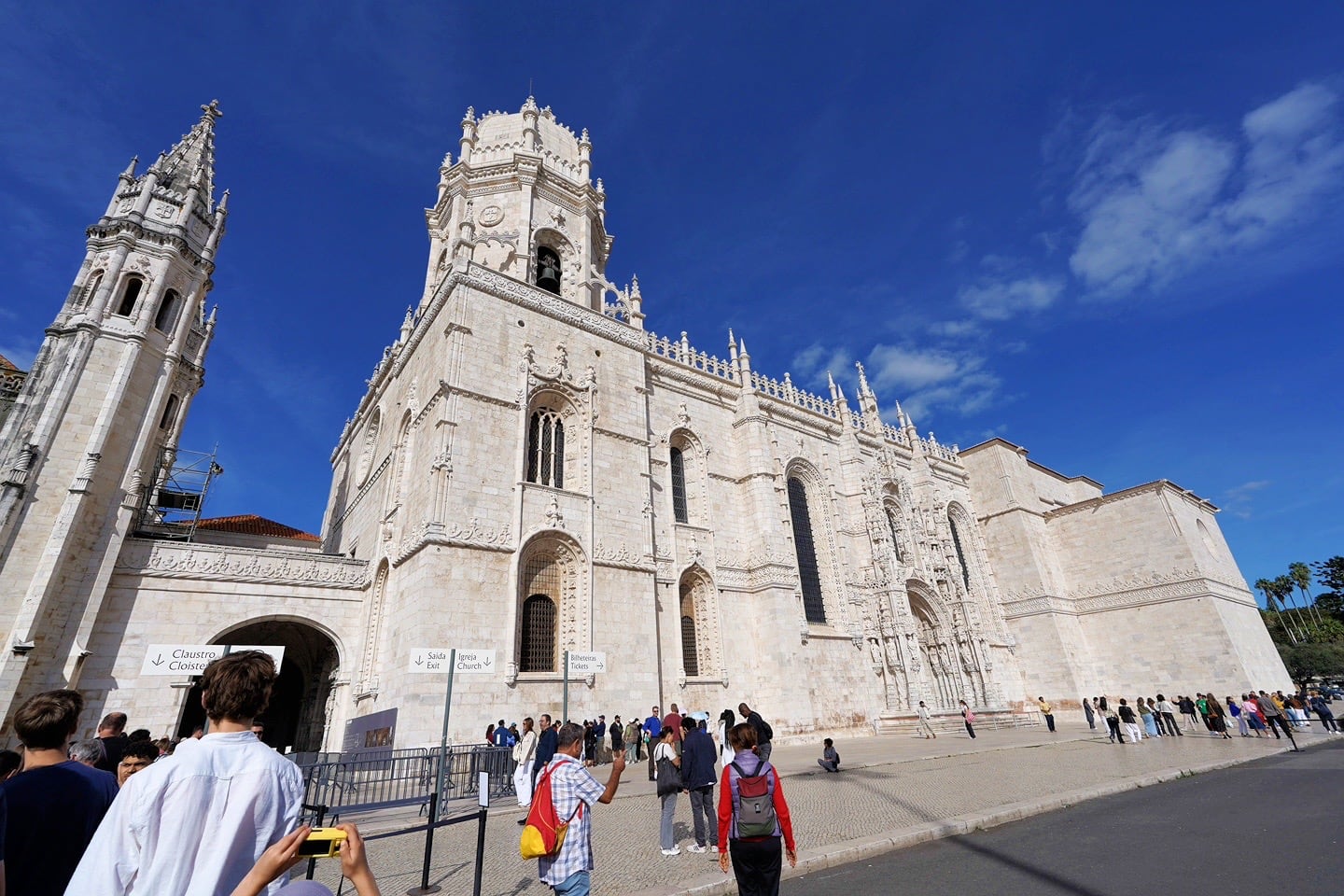
Getting the timing right on this one can make or break your visit. Here is what you might expect during different times of the year, week, and day.
Spring (March–May)
Lisbon in spring usually brings mild temperatures, clearer skies, and comfortable walking conditions—good if you’re considering combining your visit with a day exploring Belém.
Do be warned, lines increase around Easter, but mornings are usually pretty manageable.
Summer (June–August)
You can probably expect large crowds and long queues, especially late morning and afternoon. However, if you’re just visiting the monastery, buying your timed-entry ticket in advance will help you avoid much inconvenience once you get there.
The monastery stays cooler inside than many Lisbon attractions, but we think you’ll probably enjoy the outdoor cloister most early or late in the day.
Autumn (September–November)
We think autumn is one of the best seasons to visit (this is when we first visited). The weather’s still pretty warm here, but the crowds aren’t what they were during the summer months. Early mornings tend to be particularly pleasant, if you can get yourself going early.
Winter (December–February)
We’ve been told that winter is the slowest time (with an increase in foot traffic around Christmas). It can get pretty rainy, which isn’t so greater for explorations around the neighborhood. But most of the areas you’ll find yourself in inside the cloister are covered.
Best Time of Day
- Early morning (opening time): Best for photography and avoiding lines.
- Late afternoon: Warm, soft light in the cloister.
- Avoid midday: The longest queues form between 11:00 and 15:00.
Insider Tips for a Better Experience
- Arrive at opening time to avoid crowds.
- Explore the church first if you arrive before your time slot.
- Spend time with the details: carvings, symbols, and tiles.
- Pair your visit with nearby museums.
- Photograph the cloister when soft light hits the stone.
Where to Eat in Belém

Belém offers some of the best traditional foods in Lisbon.
Recommended Restaurants
- Pastéis de Belém: For pastries and light meals.
- Este Oeste: Top-rated riverside Italian spot ideal for a relaxed lunch.
- Darwin’s Café: Upscale dining with scenic river views.
Final Thoughts
We weren’t sure about Jerónimos Monastery before we visited. But one thing we have learned from years of travels across the globe is that you can rarely go wrong with UNESCO World Heritage Sites. And Jerónimos is one of only two in the city (coupled together with the Tower of Belém).
So does it live up to the hype? A lot of people, including ourselves, have been a bit surprised by how little of the huge complex seems to be opened to the public. There’s another large courtyard between the Maritime Museum and the cloister that is closed to the public, and where are the monastic quarters?
Be that as it may, we felt that visiting Jerónimos Monastery was well worth the time and money, and would encourage anyone visiting Lisbon to try to make it out here, especially give the site’s proximity to so many other notable attractions.
With that said, it is important to get the timing right and book your tickets in advance. Better yet, hop on an organized walking tour and have someone else take care of the logistics.
More Reading for Your Portugal Trip
Lisbon
Sintra
The Algarve
- Visiting Historic Silves: Where to Go + What to Know
- Sagres, Portugal: 8 Best Things to See & Do in One Day
- Our 8 Favorite Beaches in Lagos, Portugal: A Detailed Guide
- Ponta da Piedade in Lagos: Our 4 Favorite Ways to Visit
Southern Spain